

Oops! That page can’t be found.
It looks like nothing was found at this location. Maybe try a search?
NighttimeLab x SXSW 2025: The future of nightlife & wellbeing
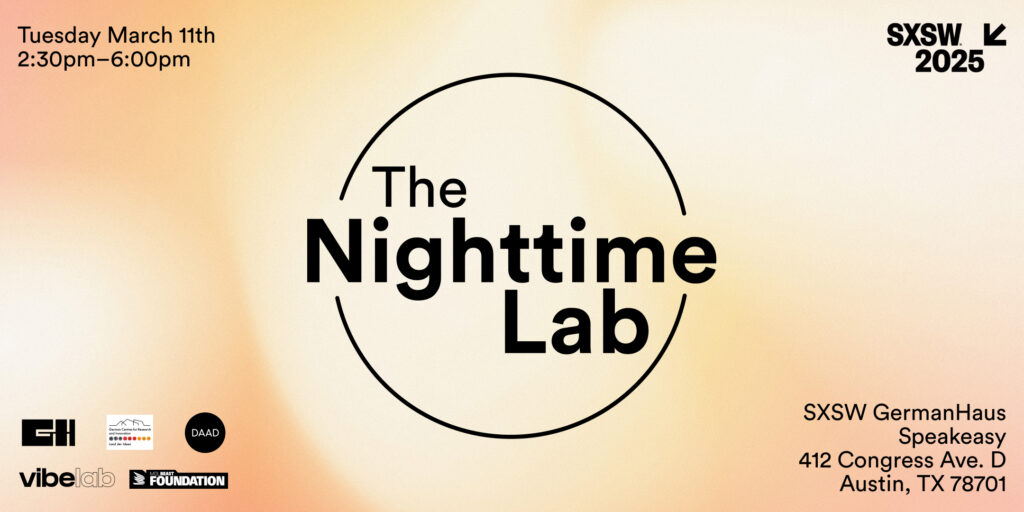
Join us at SXSW GermanHaus to explore how sound, wellbeing, and nightlife can thrive together. This year VibeLab, DWIH, DAAD, German Haus and MDLBEAST Foundation join forces to bring Nighttime Lab to life.
Nightlife is a catalyst for culture, innovation, and community. At NighttimeLab x SXSW 2025, experts, artists, and policymakers will explore how to create a healthier, more sustainable nighttime economy. This year’s focus is on hearing health, mental wellbeing, and smart policies shaping the future of the night.
- Location: SXSW GermanHaus | Speakeasy, 412 Congress Ave. D, Austin, TX
- Date & Time: Tuesday, March 11 | 2:30 – 6:00 PM
Panel talk: Sounds of the Night | 2:30 PM – 3:30 PM
Music is central to nightlife, but how does it affect mental health and wellbeing? How can we protect hearing without compromising the experience? Christian Strowa (DWIH New York) moderates a discussion with:
- Nada Alhelabi (MDLB Foundation, Saudi Arabia)
- Dr. Daniel Polley (Harvard Neuroscientist)
- Xan Damalas (Club Eternal Austin)
- DJ Wyldflower (Sunday Sessions ATX, TBC)
Workshop: Wellbeing at Night | 3:30 PM – 5:00 PM
The nightlife industry depends on creativity and connection—but mental health and safety are just as vital. This interactive workshop, led by Lutz Leichsenring (VibeLab), will provide strategies for building a culture of care with insights from:
- Brian Block (City of Austin, Sip Safely)
- Ana Arellano (Night Owl Therapy)
- Kathryn Taylor (Centro Calea, Tudo Bem)
Reception & Networking | 5:00 PM – 6:00 PM
The day concludes with music, drinks, and conversation, reception will be powered by MDLBEAST Foundation.
Program Highlights:
- Think and Do Tank: A collaborative platform for dialogue and prototyping actionable solutions.
- Training and Capacity-Building: Workshops featuring expert insights and peer-to-peer learning to enhance skills and knowledge.
- Discourse and Dialogue: Engaging discussions with Night Mayors, researchers, and nighttime professionals from Germany, the US, and beyond, fostering cross-cultural exchange and idea-sharing.
VibeLab to curate international stage at Night-Time Economy Summit 2025
The NTIA’s Night-Time Economy Summit brings together global nightlife leaders to exchange ideas, tackle challenges, and drive innovation shaping the future of nightlife. Last year, 1800 delegates from diverse backgrounds attended a range of interviews, seminars, panels and keynotes at the NTE Summit. The latest edition is set to take place on the 5th and 6th of February, 2025 at the Hockley Social Club in Birmingham, United Kingdom.
VibeLab will host and moderate a series of sessions on Day 1:
From Underground to Archive: Safeguarding Electronic Music’s Cultural Heritage
Exploring grassroots efforts, underrepresented voices and best practices to archive and bridge electronic music’s history, present and future in a digital era.
Wed, 05.02, 11:00-11:45
Moderator: Kerronia Thomas
Speakers:
- Miles Niemeijer, Music Coordinator, Podiumkunst.net (Amsterdam);
- Giuseppe Moramarco, Founder, Scene Clubbing Heritage (Berlin);
- Katherine Green, Director, Rendezvous Projects CIC (London);
- Dr. Anna Marazuela Kim, International Advisor for Culture in Cities (London).
How Independent Academies and Informal Education are Reshaping Future Culture-Makers
Empowering emerging creatives through grassroots initiatives, peer learning, and pathways to success, connecting past lessons with contemporary perspectives.
Wed, 05.02, 12:00-12:45
Moderator: Kerronia Thomas
Speakers:
- Fatima Elatik, Director, Patta Academy (Amsterdam);
- Kae Burke, Cofounder, House of Yes (New York).
- Ivan March, Communications & Curation, Waking Life Festival (Athens);
- Esther Wanyama, Community Manager, Another Life (Copenhagen) / NightSchool 2024 Alumnus;
From Vision to Impact: Turning Nighttime Strategies into Local Action
Transforming visionary nighttime strategies into actionable policies through political backing, stakeholder collaboration and practical insights to align city governance with nighttime community needs.
Wed, 05.02, 13:30-14:15
Moderator: Lutz Leichsenring
Speakers:
- Sasha Ojeda Mendoza, Nightculture Project Lead, City of Amsterdam;
- Martina Brunner, Executive Director, Vienna Club Commission;
- Mathieu Grodin, Night Mayor, City of Ottawa
- Katharin Ahrend, Managing Director, Clubcommission Berlin e.V. / Awareness Akademie (Berlin);
Building Safer Nights Together: Community-Led Approaches to Urban Nighttime Safety
Exploring safer nightlife through collaboration, inclusion and community-led initiatives, with insights from global cities and innovative practices towards fostering care and conflict resolution.
Wed, 05.02, 15:30-16:15
Moderator: Lutz Leichsenring
Speakers:
- Natalie Mets, Nighttime Advisor, City of Tallinn
- Julieta Cuneo, Night Time Policy & Strategy Lead, Greater London Authority
- Sophia Kearney, CEO, HE.SHE.THEY. (London).
- Lara Kofler, Night Management and Security, The Loft Vienna / Vienna Club Commission;
Tickets are almost sold out!
We look forward to seeing you there!
Intentional archiving of club culture and heritage
Club culture’s global influence is undeniable, yet it still struggles for legitimacy. Despite being the driving force behind nighttime economies and the laboratory for progressive visions of the future, it often remains sidelined by institutions when it comes to recognising club culture’s role in shaping society and contributing to public heritage.
Club cultural history is sprawling yet fragile, told through fragmented oral traditions, vanishing dancefloors, and the selective memory of mainstream media. Intentional archival — and not mere documentation — is crucial for legitimising and protecting dance music as a cultural form.
Unlike rock’s meticulously archived and endlessly repackaged mythology, dance music’s legacy remains precariously scattered, its history fading with each disappearing dancefloor. Nightlife is a space for experimentation and subversion, but what happens at night usually stays there. Beyond the underground networks, dance music culture is seeing the systemic erasure of the Black, queer, and working-class pioneers who built it. The industry cherry-picks its icons while entire movements are passed over, their stories shared in afterparty conversations rather than preserved in public memory.
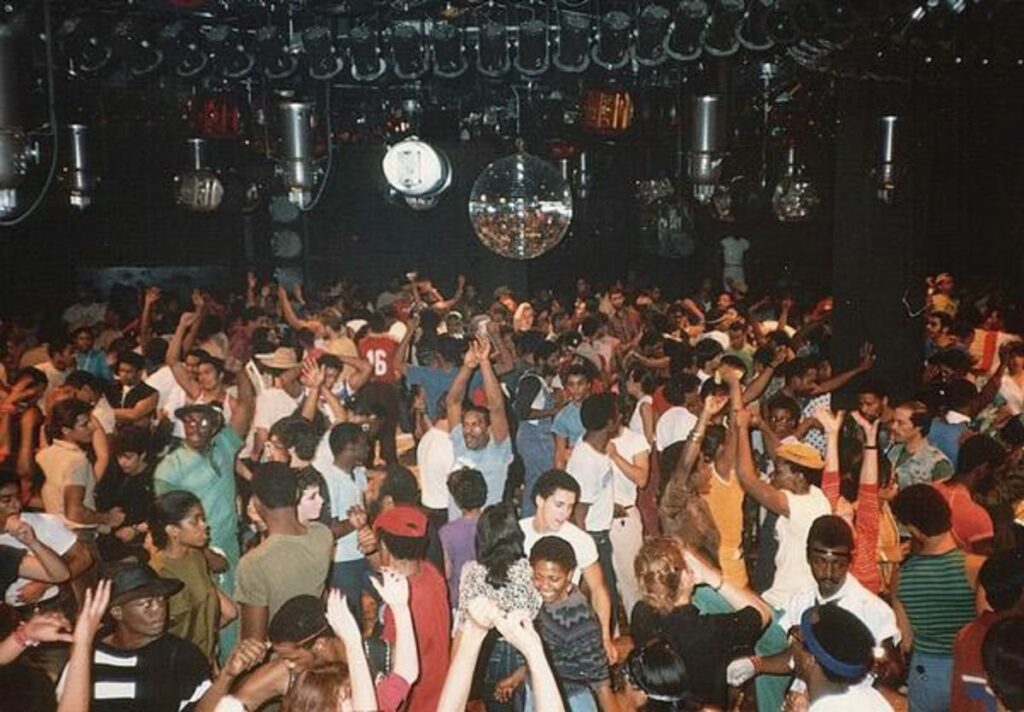
The legendary status of nightclubs like Paradise Garage in New York are the exception, not the norm in the broader cultural archive. Credits: photographer and source unknown.
The dance music world has always been good at documentation. Obsessive crate digging is matched by exhaustive collections of flyers, radio rips, grainy phone footage. Today, the commercial success of coffee table-format heritage for club culture enthusiasts is driven by collectibles such as the recently published book by legendary Brussels club Fuse, and John Leo Gillen’s book Temporary Pleasures on the history of nightclub architecture. Club culture has also received recognition beyond consumer tastes and collaborations with high art— most notably with Germany’s inclusion of Berlin’s techno scene in UNESCO’s list of intangible cultural heritage. Even outside of Western contexts, indigenous electronic dance music is being re-discovered and celebrated. In Indonesia, Funkot’s international and domestic success is acknowledging the genre beyond comparisons to gabber, a genre from the country’s former coloniser. In India, Charanjit Singh’s Ten Ragas to a Disco Beat is finally being reclaimed as a homegrown progenitor of acid house.
A cover by band Glass Beams of Raga Bhairav (1982) by Charanjit Singh, which is now celebrated in India as a homegrown pioneer of acid house.
But as Emma Warren puts it in Document Your Culture, “Documenting is the act of capturing information, while archiving is about preserving and organizing that information for the future.” Archiving requires intention. Without it, documenting dance music becomes an exercise in exploiting and gatekeeping culture. Without actively supporting the culture and communities that keep these legacies alive, history becomes a conversation piece, a fashion statement. We risk being too busy pontificating to remember to dance. In a recent article, Chal Ravens describes this tendency of ‘academisation’ and ‘museum-ification’ which has “turned the dancefloor into a kind of ideological zone of contestation rather than just a receptacle for weekend hedonism”. While this shift reflects dance music’s cultural importance, it also risks detaching it from the communities that built it. Although politics on and off the dancefloor is a laudable progression, dance music history should not be merely appropriated for the tastes of highbrow art. In our scramble to turn our passions to side-hustles and our art into content, are we losing the intangible and ephemeral experience of the night? Ravens warns that “the now late-onset celebration of rave doesn’t also serve as its eulogy”. Without intention, history is left to be rewritten by those who can afford to control the narrative.
Archiving should instead serve to strengthen and advocate for the communities at the heart of nightlife and club culture. VibeLab in collaboration with Podiumkunst.net are undertaking a project ‘Archiving Dutch Club Culture’ that aims to empower and give voice to the hidden stories of grassroots creative communities in the Netherlands. The goal is to develop a living archive that is sustainable and community-run. Senior project manager at VibeLab Thomas Scheele emphasises that “our goal is not just to collect stories, but to empower communities to document and preserve their own heritage.” The project was well received at the recent Dancecult Research Network Conference held in Berlin in January 2025, where the team presented the project’s results. Work such as this shows that intentional archiving is not just about preserving the past—it is about empowering communities to shape how their histories are told. If dance music is to resist erasure, its archiving must be a living, participatory act, driven by the very people who sustain its culture.
In July, VibeLab in collaboration with Podiumkunst.net published the report “Archiving Dutch Night and Club Culture”, which explores how nightlife communities, artists and institutions in the Netherlands are documenting and safeguarding club culture history. The report includes case studies, stakeholder insights and practical tools for grassroots communities to document their own culture. Recommendations will be shared with cultural institutions and city officials later this year. The report is available online for free download in English and Dutch.